Chinese Structural Steel Grades vs ASTM and EN Standards: What Overseas Buyers Should Know
For overseas contractors, developers, and procurement managers, sourcing structural steel from China often involves understanding different material standards.
A project designed under American or European standards may specify steel grades such as ASTM A572 Grade 50, ASTM A992, or S355JR. Meanwhile, Chinese steel mills and fabricators commonly work with domestic grades such as Q235 and Q355.
Although some of these materials have similar nominal strength levels, they are not necessarily interchangeable.
Differences in chemical composition, mechanical properties, impact toughness, product requirements, and certification can affect whether a material is suitable for a particular project.
This guide explains common Chinese structural steel grades, how they compare with ASTM and EN specifications, and what overseas buyers should verify before approving a material substitution.
1. Understanding Chinese Structural Steel Grades
China uses a national standards system known as GB (Guobiao). Many structural steel products are specified under GB/T standards, which are recommended national standards that may also be adopted as contractual requirements.
Two important standards frequently encountered in Chinese structural steel procurement are GB/T 700 and GB/T 1591.
GB/T 700: Carbon Structural Steels
GB/T 700-2006 covers carbon structural steels, including commonly used grades such as Q235.
Q235 steel is widely encountered in Chinese construction and industrial fabrication, particularly for structural components where its specified properties meet the applicable design requirements.
The standard covers relevant carbon structural steel products and establishes requirements relating to material properties, testing, inspection, and delivery documentation.
GB/T 1591: High Strength Low Alloy Structural Steels
GB/T 1591-2018 covers high-strength low-alloy structural steels, including the Q355 series.
Q355 is commonly specified for structural applications requiring a higher nominal yield strength than Q235.
However, the required material properties depend on the specific grade, product dimensions, delivery condition, and applicable requirements of the standard.
For example, Q355B, Q355C, and Q355D should not be treated as identical materials simply because they belong to the Q355 strength class.
What Do Q235B and Q355B Mean?
Chinese structural steel designations provide information about the material’s strength class and quality grade.
For example:
| Designation | General Meaning |
|---|---|
| Q | Refers to yield strength, based on the Chinese Pinyin “Qu” |
| 235 / 355 | Nominal yield strength class expressed in MPa |
| B | Quality-grade designation under the applicable material standard |
The numerical strength designation does not mean that every product thickness has exactly the same guaranteed yield strength.
The applicable standard may specify different mechanical property requirements depending on thickness and other conditions.
Similarly, the letter B is a quality-grade designation, not an indication that materials carrying the same letter under different standards have identical properties.
For overseas buyers, the full material designation, product form, standard edition, and relevant technical requirements should be confirmed before placing an order.
The key takeaway: Chinese structural steel grades provide useful information about material classification, but a steel grade name alone is not sufficient to establish compliance with an international project’s specifications.
2. GB vs ASTM vs EN: Understanding the Differences
Structural steel projects around the world may specify materials according to Chinese GB, American ASTM, or European EN standards.
Although these standards serve similar purposes in defining steel product requirements, they are not directly interchangeable.
Each standard has its own scope, applicable product forms, material grades, mechanical properties, chemical composition requirements, and testing provisions.
For overseas buyers sourcing structural steel from China, understanding these differences is essential before comparing material prices or approving alternative grades.
Chinese GB Material Standards
China’s GB and GB/T standards cover a wide range of steel products used in construction and industrial applications.
As discussed in the previous section, GB/T 700 specifies carbon structural steels, while GB/T 1591 covers high-strength low-alloy structural steels.
These standards establish material requirements, but buyers must also identify the relevant product dimensions, delivery conditions, testing requirements, and other applicable specifications.
A Chinese fabricator may source steel from domestic mills according to the project’s specified material requirements.
However, supplying steel under a Chinese material standard does not automatically establish compliance with an ASTM or EN specification.
Common American ASTM Structural Steel Standards
ASTM International publishes material specifications covering different categories of structural steel products.
Three commonly encountered standards are:
| ASTM Standard | Main Product Application |
|---|---|
| ASTM A572/A572M | High-strength low-alloy structural steel shapes, plates, sheet piling, and bars |
| ASTM A992/A992M | Rolled structural steel shapes used in building framing and other structural applications |
| ASTM A500/A500M | Cold-formed welded and seamless structural tubing, including round, square, and rectangular sections |
These standards are not simply different names for the same material.
For example, a project may specify ASTM A992 for rolled wide-flange beams and ASTM A500 Grade C for hollow structural sections.
Although both products may be used in the same steel structure, they are subject to different material specifications.
The correct standard depends on the product type and the approved project requirements.
Common European EN Structural Steel Standards
European structural steel products are also covered by different standards according to their manufacturing methods and product forms.
| EN Standard | Main Product Application |
|---|---|
| EN 10025-2 | Hot-rolled non-alloy structural steel products, including applicable flat and long products |
| EN 10210-1 | Hot-finished structural hollow sections |
| EN 10219-1 | Cold-formed welded structural hollow sections |
For example, a European project may specify S355J2 steel products under EN 10025-2.
However, structural hollow sections require consideration of the applicable hollow-section standards, such as EN 10210 or EN 10219.
Hot-finished and cold-formed hollow sections may differ in manufacturing processes, dimensional properties, and other technical requirements.
Therefore, buyers should not assume that an S355 designation alone fully defines the required steel product.
Material Standards vs Structural Design and Fabrication Standards
Another important distinction is the difference between material specifications and standards governing structural design or fabrication.
For example:
- ASTM A572, A992, and A500 define requirements for specified steel products.
- ANSI/AISC 360 provides requirements for the design and construction of structural steel buildings.
- EN 1090-2 establishes technical requirements for the execution of structural steelwork.
These standards address different aspects of a structural steel project.
A manufacturer may have the capability to fabricate structural steel according to a specified fabrication standard while still needing to verify that the purchased raw materials comply with the required material specification.
The key takeaway: Overseas buyers should identify the exact material standard, steel grade, product form, applicable edition, and additional technical requirements before placing an order with a Chinese structural steel fabricator.
3. Q355B vs S355JR vs ASTM A572 Grade 50
Q355B, S355JR, and ASTM A572 Grade 50 are frequently compared in international structural steel procurement because they belong to broadly similar strength categories.
However, similar strength levels do not mean these steel grades are technically equivalent or automatically interchangeable.
Their requirements for mechanical properties, chemical composition, impact toughness, product dimensions, and testing may differ.
For overseas buyers, these differences must be understood before considering any material substitution.
Comparing Yield and Tensile Strength
Yield strength is one of the most important properties used in structural steel design.
The following table provides a simplified comparison of selected mechanical properties for applicable hot-rolled products.
| Steel Grade | Material Standard | Minimum Yield Strength | Tensile Strength |
|---|---|---|---|
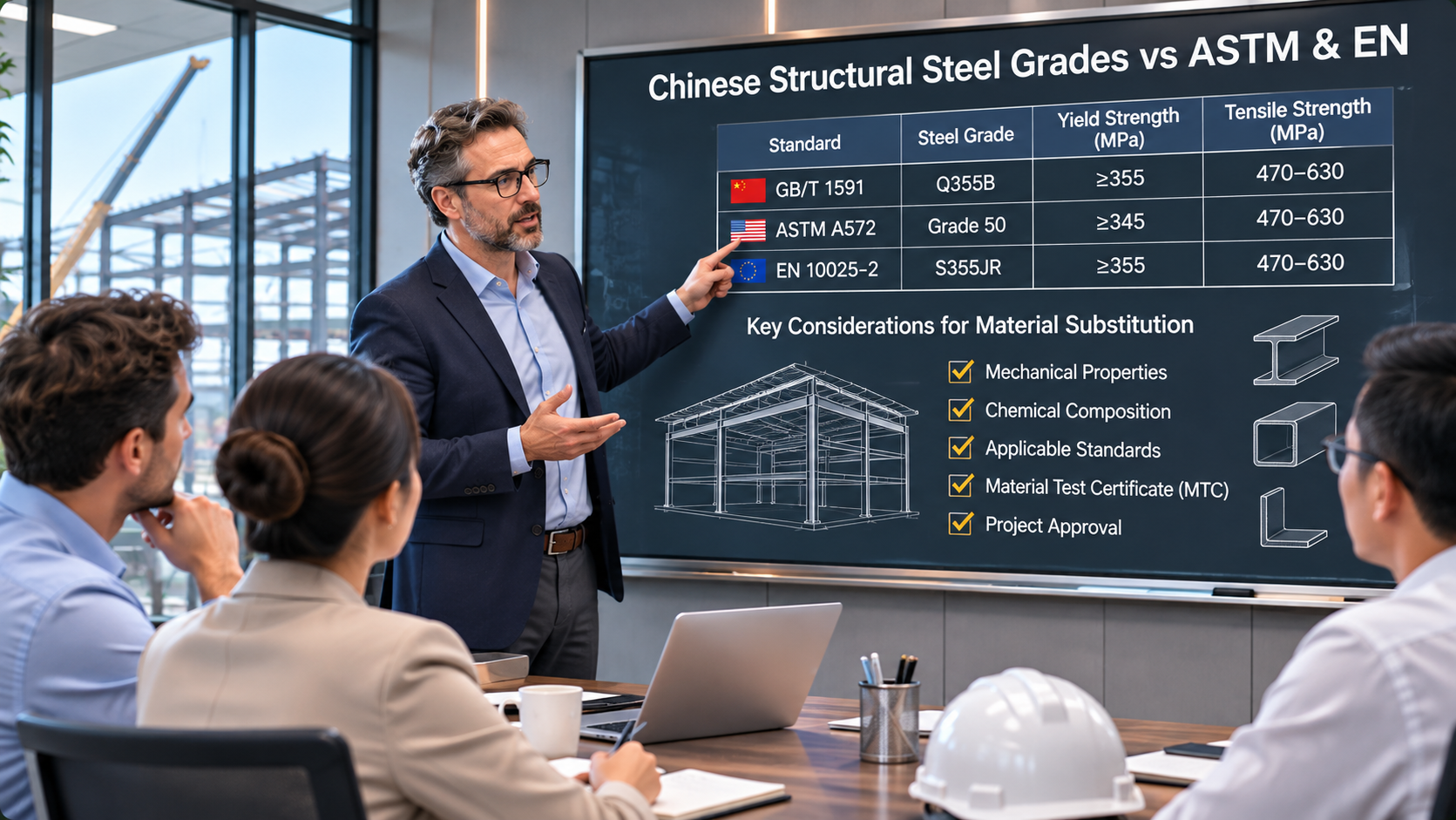
| Q355B | GB/T 1591-2018 | 355 MPa | 470–630 MPa |
| S355JR | EN 10025-2:2019 | 355 MPa | 470–630 MPa |
| ASTM A572 Grade 50 | ASTM A572/A572M | 345 MPa | Minimum 450 MPa |
Important: These figures are simplified reference values for applicable products at nominal thicknesses of approximately 3–16 mm. They are not complete material specifications. Requirements may vary with thickness, product form, delivery condition, and the applicable standard edition.
For example, Q355B and S355JR may share the same specified minimum yield strength at certain thicknesses.
However, ASTM A572 Grade 50 has a specified minimum yield strength of 345 MPa, which is slightly lower.
A higher or similar nominal strength value alone is not sufficient to establish material equivalence.
Impact Toughness and Testing Requirements
Impact toughness is another important consideration, particularly for structures exposed to low temperatures or where resistance to brittle fracture is important.
Different material standards may specify different testing conditions.
For example:
- Q355B: Under applicable GB/T 1591-2018 requirements, standard longitudinal Charpy V-notch specimens have a specified minimum impact energy of 34 J at +20°C.
- S355JR: The JR quality designation under EN 10025-2 specifies an impact energy reference of 27 J at +20°C.
- ASTM A572 Grade 50: Project-specific notch toughness requirements may need to be agreed between the purchaser and producer.
These figures should not be compared without considering specimen dimensions, orientation, testing conditions, product thickness, and inspection requirements.
Furthermore, the presence of a toughness requirement in a material specification does not necessarily mean every delivered product will automatically include the same impact test documentation. The applicable standard provisions and purchase order requirements must be checked.
For example, a European project specifying S355J2 requires consideration of impact properties at −20°C.
A supplier cannot demonstrate compliance simply by offering Q355B with similar nominal yield strength.
Chemical Composition and Weldability
Chemical composition can also affect whether a material is suitable for a particular structural application.
Different material standards establish limits or requirements for elements such as carbon, manganese, silicon, phosphorus, sulfur, and relevant alloying elements.
These differences can influence weldability, material processing, and the selection of appropriate welding procedures.
For example, a fabricator proposing an alternative steel grade should verify the material’s chemical composition and carbon equivalent where relevant.
The project may also require confirmation that existing welding procedures remain suitable for the proposed material.
An alternative grade should not be accepted solely because it has a similar yield strength or because the fabricator has used it successfully on other projects.
Product Thickness and Delivery Conditions
Mechanical properties may vary according to the thickness and manufacturing condition of the supplied material.
For both Q355B and S355JR, the specified minimum yield strength generally decreases across certain thicker product ranges.
Material delivery conditions may also affect applicable requirements.
Therefore, buyers should confirm:
- The applicable material specification and edition
- The required product form and dimensions
- The specified mechanical properties at the relevant thickness
- The required delivery condition
- Any additional testing or inspection requirements
These details are particularly important when purchasing heavy steel plates, large structural sections, or materials for demanding structural applications.
Are Q355B, S355JR and ASTM A572 Grade 50 Interchangeable?
The three grades may be considered as preliminary comparison candidates during material sourcing.
However, they should not be described as directly interchangeable without a project-specific technical assessment.
A proper evaluation should consider mechanical properties, chemical composition, impact toughness, product requirements, weldability, applicable design rules, and certification.
If a Chinese fabricator proposes Q355B instead of S355JR or ASTM A572 Grade 50, the proposed substitution should be documented and reviewed by the responsible project engineer or other authorized approving party.
The key takeaway: Similar strength classifications can help identify potential alternative materials, but compliance must be established against the full project specification—not merely the steel grade designation.
4. Why Similar Steel Grades Are Not Always Interchangeable
A common challenge in international structural steel procurement is evaluating alternative materials proposed by suppliers.
A Chinese fabricator may suggest a domestic steel grade because it is more readily available, offers a shorter procurement lead time, or reduces material purchasing costs.
However, a proposed substitution must satisfy the project’s technical and contractual requirements.
Example: Replacing S355J2 with Q355B
Consider a hypothetical industrial building project in Europe.
The approved structural drawings specify S355J2 steel under EN 10025-2.
During procurement, a Chinese fabricator proposes using Q355B under GB/T 1591-2018.
Both grades may have a nominal minimum yield strength of 355 MPa within certain product thickness ranges.
However, their impact toughness requirements differ.
Under applicable standard conditions, S355J2 specifies a minimum Charpy V-notch impact energy of 27 J at −20°C, while Q355B specifies 34 J at +20°C for standard longitudinal specimens.
These results cannot be directly compared because the test temperatures are different.
Consequently, supplying Q355B does not automatically demonstrate compliance with a project specification requiring S355J2.
What Must Be Evaluated?
Before considering the alternative, the responsible technical team should evaluate whether the proposed material satisfies the relevant project requirements.
Important considerations include:
- Mechanical properties at the specified product thickness
- Chemical composition and relevant weldability requirements
- Impact toughness and required testing temperatures
- Material product form and delivery condition
- Applicable design codes and project specifications
- Inspection, documentation, and certification requirements
Additional material testing may help demonstrate specific properties, but it does not automatically establish full equivalence with another material standard.
Similarly, a material test certificate confirms reported properties and inspection information for the supplied material; it is not, by itself, approval to replace the specified grade.
Material Substitution Requires Formal Approval
If the supplier cannot provide the originally specified material, the appropriate approach is to submit a documented alternative for technical review.
The proposal should clearly identify the original specification, proposed alternative, relevant technical differences, and supporting material documentation.
The responsible project engineer or another authorized approving party must determine whether the substitution is acceptable under the applicable project requirements.
Until approval is obtained, the fabricator should not assume that the alternative material can be used.
The key takeaway: Similar nominal strength does not establish material equivalence. Any proposed substitution must be technically evaluated and formally approved before procurement or fabrication proceeds.
5. How Overseas Buyers Should Verify Material Compliance
Verifying material compliance is an essential part of sourcing structural steel from China, particularly when a project specifies ASTM or EN standards.
A fabricator’s general manufacturing capabilities do not automatically guarantee that every batch of purchased steel meets the required material specifications.
International buyers should therefore establish a clear verification process before approving material procurement.
Step 1: Confirm the Exact Material Requirements
Before requesting quotations, buyers should identify the material requirements specified in the approved project documents.
These normally include:
- Material standard and applicable edition
- Required steel grade
- Product form, dimensions, and thickness
- Mechanical property requirements
- Impact toughness requirements, where applicable
- Inspection certificates and additional testing requirements
For example, specifying only “S355 steel” may not provide sufficient information for purchasing the correct material.
The applicable product standard, quality designation, dimensions, and additional technical requirements should also be established.
Step 2: Verify Material Availability with the Supplier
After reviewing the requirements, the Chinese fabricator should confirm whether the specified steel can be obtained from suitable steel mills or distributors.
The buyer may request confirmation of material availability, expected procurement lead time, and required documentation.
If the specified material is not readily available, the supplier should identify the issue before submitting a final quotation or placing a material order.
An alternative material should not be assumed acceptable simply because it is easier to obtain or less expensive.
Step 3: Review Material Test Certificates
Material Test Certificates (MTCs), also referred to as Mill Test Reports (MTRs) in some contexts, provide important information for material verification.
Depending on the applicable standard and purchase requirements, relevant information may include:
| Information to Check | Purpose |
|---|---|
| Material specification and grade | Confirm the ordered material designation |
| Steel manufacturer | Identify the material producer |
| Heat or batch number | Connect materials with their inspection records |
| Chemical composition | Check specified chemical requirements |
| Mechanical test results | Verify reported strength and other required properties |
| Additional test results | Confirm specified impact or other testing requirements |
For projects requiring documentation under EN 10204, the required inspection certificate type should be established before ordering.
For example, Type 3.1 certificates are validated by the manufacturer’s authorized inspection representative who is independent of the manufacturing department. Type 3.2 involves additional validation by an authorized purchaser’s representative or an inspector designated under applicable regulations.
The certificate type alone does not establish compliance with every project requirement.
Step 4: Confirm Material Identification and Traceability
Material identification and traceability should be considered during procurement and fabrication planning.
Depending on the contract, the supplier may need to maintain records linking material certificates to purchased steel and fabricated components.
Requirements may range from basic material grade identification to more detailed heat-number tracking.
The required level of traceability should be specified before procurement because additional tracking and documentation can increase costs.
Buyers should also confirm how material identification will be maintained after cutting and fabrication, where applicable.
Step 5: Manage Material Substitutions Through Written Approval
If the specified steel grade is unavailable, the supplier may propose an alternative.
The proposal should identify the original material specification, proposed grade, relevant technical differences, and supporting evidence.
For example, if a European project specifies S355J2 and a Chinese supplier proposes Q355B, the differences in impact toughness requirements must be evaluated alongside other applicable technical criteria.
A material test certificate or additional test result does not automatically authorize substitution.
The responsible project engineer or other authorized approving party should review the proposal and provide the required written approval before the alternative material is purchased or fabricated.
A Practical Procurement Verification Checklist
Before approving material procurement, overseas buyers should confirm that:
- The required material standard, grade, and product form are clearly identified.
- The supplier has confirmed material availability and documentation requirements.
- The required inspection certificates can be provided.
- Material identification and traceability requirements are agreed.
- Any alternative material has received the necessary written technical approval.
For construction products supplied to regulated markets, buyers should also check whether separate product declarations, conformity assessment, or marking requirements apply.
The key takeaway: Successful international structural steel procurement requires more than selecting a similar steel grade. Buyers should verify material specifications, supplier documentation, traceability requirements, and technical approvals before manufacturing begins.
6. Final Thoughts: Verify Before Substituting
Understanding the differences between Chinese GB, American ASTM, and European EN structural steel standards is essential for international procurement.
Although certain steel grades may have similar nominal strength levels, this does not automatically make them interchangeable.
Material compliance depends on the applicable product standard, mechanical properties, chemical composition, impact toughness, manufacturing conditions, and project-specific requirements.
For overseas buyers sourcing structural steel from China, the safest approach is to verify material requirements before procurement begins.
A clearly prepared structural steel RFQ should identify the required material specifications, while choosing a structural steel fabricator in China should also involve verifying the supplier’s ability to obtain compliant materials and provide appropriate documentation.
If an alternative steel grade is proposed, the technical differences should be documented and reviewed by the responsible project engineer or other authorized approving party.
The key takeaway: Material substitution should be based on verified technical compliance and formal approval—not simply similar steel grade names or nominal strength values.
SteelSourcing Compass provides independent sourcing insights to help overseas buyers understand material specifications, evaluate Chinese structural steel suppliers, and make informed procurement decisions.