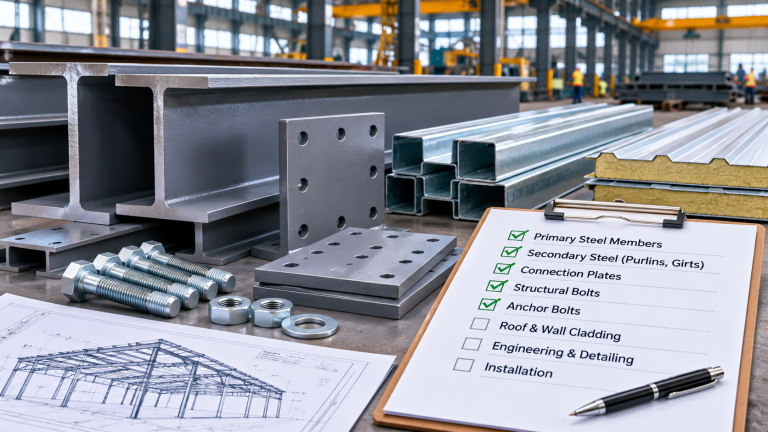
Structural Steel Fabrication Cost in China: A Practical Guide for Overseas Buyers
For international contractors, developers, and procurement managers, understanding structural steel fabrication costs in China is an important part of project budgeting.
However, comparing steel fabrication prices is not as simple as checking a quotation per metric tonne.
Two suppliers may offer different prices for the same warehouse or industrial building because of differences in material requirements, fabrication complexity, production methods, protective coatings, and other manufacturing costs.
A lower price per tonne does not necessarily mean a lower total procurement cost.
This guide explains the main cost components of fabricated structural steel in China, how manufacturing complexity affects pricing, and how overseas buyers can develop a preliminary fabrication budget.
1. How Much Does Structural Steel Fabrication Cost in China?
There is no single fixed price per metric tonne for fabricated structural steel in China.
The price depends on the type of steel, the manufacturing requirements, the quantity ordered, and the scope of the supplier’s quotation.
Before comparing prices, buyers should distinguish between three common pricing categories.
| Pricing Category | What It Generally Includes |
|---|---|
| Raw steel material price | Steel sections, plates, and other raw steel products before project-specific fabrication |
| Fabrication-only cost | Manufacturing services such as cutting, drilling, assembly, and welding, generally excluding raw steel materials |
| Fabricated steel supply price | Raw steel materials and fabrication services, together with other items specified in the agreed supply scope |
These categories are not directly comparable because they represent different products and services.
Understanding Raw Steel Prices in China
Raw steel prices provide a useful starting point for estimating structural steel fabrication costs.
For example, according to a Mysteel market report published on November 6, 2026, China’s H-section steel price index averaged approximately RMB 3,299.29 per metric tonne during October 2026.
This figure is a historical market indicator for H-section steel. It does not represent the total cost of a fabricated structural steel package.
Actual material purchasing prices depend on steel grade, product dimensions, quantity, supplier availability, and market conditions.
A fabricated structural steel quotation may also include processing, welding, surface treatment, quality inspection, packaging, and other manufacturing expenses.
The important distinction is that the price of raw steel is not the same as the price of finished fabricated structural steel.
2. Main Components of Structural Steel Fabrication Cost
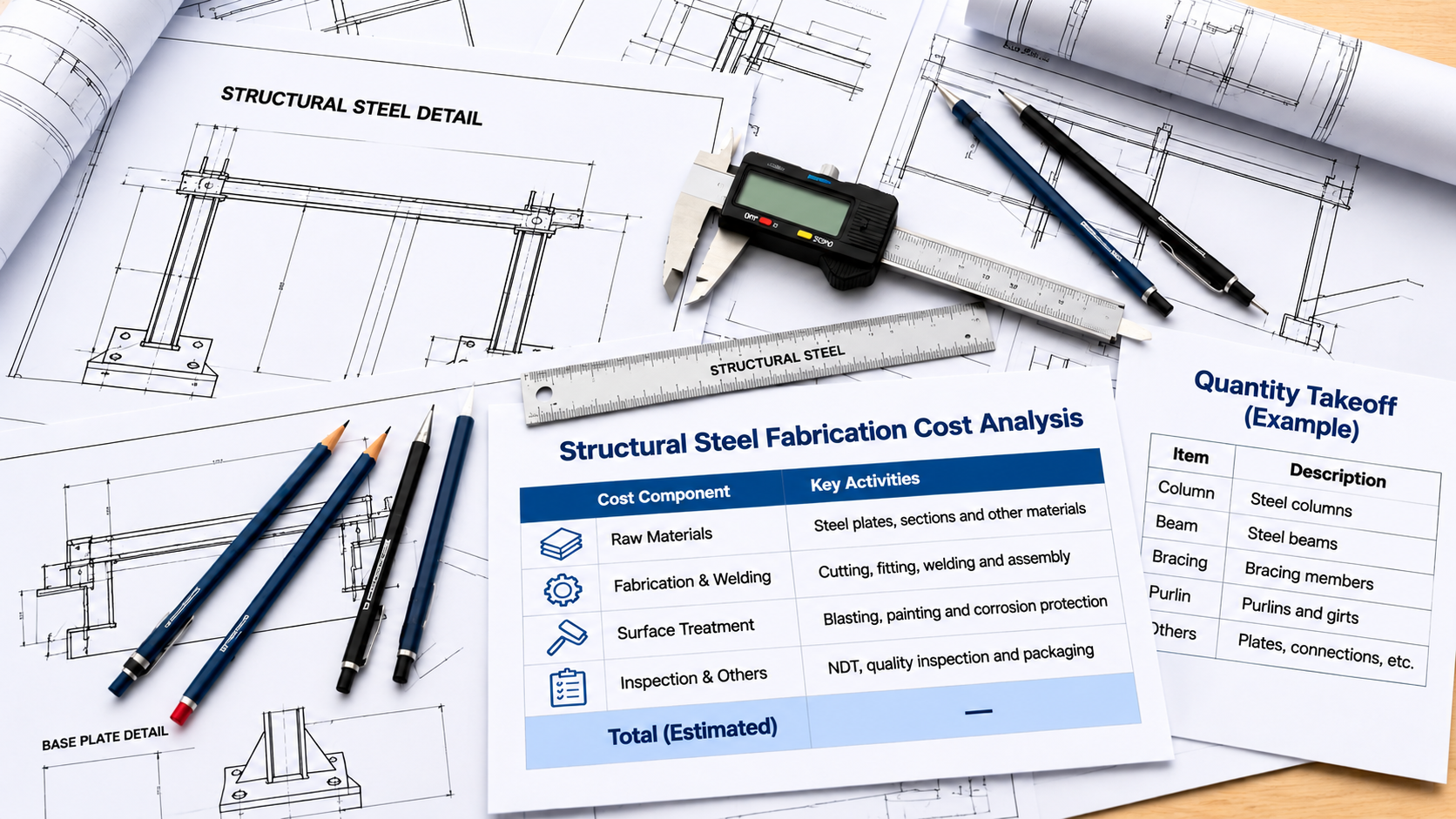
The cost of fabricated structural steel generally consists of several major components.
Understanding these components helps buyers evaluate whether a quotation is reasonable and identify which project requirements may increase the price.
| Cost Component | Main Cost Drivers |
|---|---|
| Raw steel materials | Steel grades, section sizes, plate thicknesses, purchasing quantities, and material utilization |
| Fabrication and welding | Cutting, drilling, assembly, welding, component complexity, and manufacturing hours |
| Engineering and detailing | Shop drawings, connection detailing, technical coordination, and revisions where included |
| Surface treatment | Blasting, painting, galvanizing, coating requirements, and inspection |
| Quality inspection | Dimensional checks, testing, documentation, and third-party inspection where required |
| Packaging and handling | Component dimensions, protection requirements, packing materials, and loading |
| Factory overhead and profit | Equipment, facilities, management, financing, and commercial margin |
These costs may be included in a single unit price or presented as separate quotation items.
Raw Material Costs
Raw materials usually represent an important portion of the total structural steel supply cost.
Typical materials include hot-rolled H-sections, steel plates, hollow structural sections, angles, and channels.
Material purchasing costs depend on the specified grade, dimensions, required certificates, purchase quantity, and availability.
Material utilization also matters.
During fabrication, cutting steel sections and plates to the required dimensions can generate offcuts and processing waste.
For this reason, the total weight of purchased raw materials may exceed the final theoretical weight of the fabricated components.
Recoverable scrap, reusable offcuts, and material remaining in inventory may offset part of the purchasing cost.
A proper material estimate should therefore distinguish between purchased material quantity and the weight used as the contract pricing basis.
Fabrication and Welding Costs
Fabrication includes the processes required to transform raw steel into structural components.
These commonly involve cutting, drilling, edge preparation, fit-up, assembly, welding, and dimensional inspection.
Manufacturing costs depend on the type and complexity of the components.
For example, a standard rolled beam requiring cutting and drilling may be easier to manufacture than a built-up box column containing numerous stiffeners, connection plates, and demanding weld details.
Even when two components have the same weight, their fabrication costs may differ because of the number of operations and manufacturing hours required.
Production efficiency, equipment capabilities, welding procedures, and component repetition can all influence the cost per tonne.
Engineering and Detailing Costs
Some structural steel suppliers provide shop detailing or other engineering-related services as part of their quotation.
These services may include fabrication drawings, connection detailing, technical coordination, and revisions.
However, structural design, connection design, and shop detailing are different responsibilities.
The quotation should identify which services are included and which require separate arrangements.
Surface Treatment Costs
Surface treatment is another important cost component.
Common options include shop primers, multi-coat protective painting systems, and hot-dip galvanizing.
For painted steel, costs depend on surface preparation, coating materials, number of coats, specified dry film thickness, and inspection requirements.
For galvanized steel, costs can be affected by component dimensions, geometry, handling, galvanizing requirements, and transportation to the galvanizing facility.
A basic shop primer should not be considered equivalent to a complete corrosion-protection system.
Quality Control and Inspection Costs
Quality control can involve material verification, dimensional inspection, welding inspection, non-destructive testing, coating checks, and documentation.
The required inspection scope depends on the project’s specifications and applicable standards.
Additional testing, independent inspections, or extensive documentation requirements may increase manufacturing and project administration costs.
These requirements should be identified before the supplier finalizes its price.
Export Packaging and Handling Costs
Steel components intended for overseas shipment may require transportation frames, timber supports, bundling, protective materials, marking, and specialized loading arrangements.
Packaging requirements depend on component dimensions, surface protection, and the selected transport method.
Factories also incur management, equipment maintenance, utilities, and other operating expenses.
These costs, together with the supplier’s commercial margin, may be included within the overall selling price.
3. Why Fabrication Costs Vary Between Projects
Two structural steel projects with the same total weight can have significantly different fabrication costs.
The main reason is that steel weight alone does not reflect the amount of manufacturing work required.
Component Complexity
Consider two projects with an identical total fabricated steel weight of 100 metric tonnes.
One consists mainly of repetitive beams and columns for a standard industrial warehouse.
The other contains numerous built-up members, welded connection assemblies, stiffeners, and non-standard structural components.
The second project may require more cutting, fit-up, welding, handling, and inspection work.
Consequently, its fabrication cost per tonne may be higher, even though the total weight is the same.
Welding and Connection Requirements
Welding costs are influenced by joint preparation, weld size, accessibility, welding position, number of passes, and inspection requirements.
A component requiring extensive groove welding may demand more fabrication work than one using relatively simple fillet welds.
Similarly, complex or highly varied connection details can increase production setup time and labor requirements.
Standardized connections may improve fabrication efficiency, provided that all design requirements are maintained.
Production Quantity and Repetition
Projects containing repeated components can often benefit from efficient production planning.
Repeated dimensions and connection details may reduce setup changes, simplify cutting and drilling operations, and improve production efficiency.
However, larger quantities do not automatically guarantee lower unit costs.
The actual benefit depends on component repetition, production capacity, material utilization, and manufacturing methods.
For buyers, this means a fabrication price from one project should not automatically be used as the benchmark for another project with different structural details.
4. Example: Estimating a Structural Steel Fabrication Budget
A simplified cost calculation can help overseas buyers understand how a fabricated structural steel price is built up.
The following example is hypothetical and is intended to demonstrate a budgeting method rather than provide actual Chinese market quotations.
Project Assumptions
Consider a preliminary structural steel package for an industrial warehouse with the following assumptions:
- Estimated finished fabricated steel weight: 100 metric tonnes
- Estimated raw steel purchasing quantity: 105 metric tonnes
- Steel structure: Mainly standard beams and columns
- Fabrication: Cutting, drilling, assembly, and welding
- Surface treatment: A specified protective painting system
- Delivery basis: Factory-level cost illustration, excluding international transportation
For simplicity, the additional five tonnes of raw material represent an assumed allowance for purchasing lengths, cutting losses, and material utilization. Actual recoverable scrap or reusable material would need to be accounted for separately.
Illustrative Cost Calculation
| Cost Item | Assumed Calculation | Estimated Amount (RMB) |
|---|---|---|
| Raw steel materials | 105 t × 3,600 RMB/t | 378,000 |
| Fabrication and welding | 100 t × 1,800 RMB/t | 180,000 |
| Surface treatment | 100 t × 700 RMB/t | 70,000 |
| Quality inspection and documentation | Project allowance | 25,000 |
| Packaging and handling | Project allowance | 35,000 |
| Factory overhead and commercial margin | Project allowance | 85,000 |
| Total estimated package price | 773,000 |
Based on an estimated finished fabricated weight of 100 metric tonnes:
Estimated price per tonne = RMB 773,000 ÷ 100 tonnes = RMB 7,730 per tonne
This figure is not a published Chinese industry average, supplier quotation, or recommended selling price. All rates and allowances in this example are hypothetical.
For this illustrative calculation, the fabrication and welding cost represents direct manufacturing expenses only. Factory overhead and commercial margin are included separately to avoid double counting. Actual supplier quotations may combine these costs into a single unit rate.
It is a simplified illustration that excludes taxes, detailed engineering variations, export charges, international freight, import duties, and site installation. The applicable tax treatment and final commercial delivery terms would need to be established separately.
What Can Change This Estimate?
If the same project requires more complex welded assemblies, the fabrication cost may increase.
If the specified painting system is replaced with hot-dip galvanizing, the surface treatment cost must be recalculated.
If additional material tests, third-party inspections, or specialized export packaging are required, separate allowances may be necessary.
Similarly, a change in steel material prices can significantly affect the total budget.
The calculation should therefore be treated as a preliminary estimate based on clearly stated assumptions.
Purchased Weight vs Finished Weight
Notice that this example uses two different quantities:
- 105 tonnes of purchased raw materials
- 100 tonnes of estimated finished fabricated steel
The material cost is calculated using the assumed purchased quantity.
The illustrative unit selling price is calculated using the assumed finished fabricated weight.
In actual procurement, the final contract may use theoretical weight, agreed bill-of-quantity weight, or another defined measurement method.
The applicable weight calculation and payment rules must be established in the contract.
5. What Can Make a Structural Steel Cost Estimate Inaccurate?
A preliminary cost estimate is useful, but several factors can create differences between an early budget and the final supplier quotation.
Incomplete Drawings and Quantity Information
Early project estimates may be based on preliminary structural drawings or approximate steel quantities.
As the design develops, member sizes, connection details, and material quantities may change.
These changes can affect material purchasing requirements and fabrication workloads.
A budget estimate should always identify the drawings and quantity assumptions on which it is based.
Material Grades and Technical Specifications
Different material requirements can affect procurement availability, cost, and lead time.
For example, projects specifying particular ASTM or EN material grades may require additional verification of supplier availability and material documentation.
Steel grades with similar nominal strength should not be considered automatically interchangeable.
Any proposed substitution must be reviewed against the applicable project requirements and approved by the responsible parties.
Changes in Surface Treatment or Inspection Scope
Changes to coating systems, inspection requirements, or quality documentation can also affect costs.
A quotation based on basic shop primer cannot be directly compared with one requiring extensive surface preparation and a multi-coat protective system.
Similarly, additional non-destructive testing or third-party inspection requirements may increase project costs.
Market Prices and Currency Fluctuations
Steel prices can change between the initial budget estimate and the actual material purchasing date.
Exchange-rate movements may also affect international quotations, particularly when costs are incurred in RMB while the sales contract is denominated in another currency.
Buyers should therefore check the quotation validity period and the commercial assumptions used by the supplier.
Different Pricing and Delivery Bases
A factory-level fabrication estimate is not the same as the total landed cost of importing structural steel.
Depending on the agreed delivery terms, additional costs may include export procedures, inland transport, port handling, sea freight, insurance, destination charges, customs duties, and inland delivery at the destination.
The final procurement budget should separately consider these expenses when relevant.
For a detailed explanation of supply boundaries, buyers can refer to a structural steel scope of supply checklist. A well-prepared RFQ can also help suppliers provide quotations based on consistent requirements.
6. Final Thoughts: Understanding the Real Cost of Fabricated Steel
Structural steel fabrication costs in China are influenced by more than the price of raw steel.
Material utilization, manufacturing complexity, welding requirements, surface treatment, quality inspection, packaging, and factory operating costs all contribute to the final quotation.
For overseas buyers, the most useful approach is to understand how the price is calculated rather than relying on a generic cost per tonne.
A preliminary cost model can support early project budgeting, but it should not replace a supplier quotation based on appropriate technical documents and a clearly defined supply scope.
Once the budget is clear, the next step is to choose a structural steel fabricator in China that can meet the project’s technical, quality, and delivery requirements.
The objective is not simply to identify the lowest fabrication price, but to understand the cost drivers and make a purchasing decision based on reliable technical and commercial information.
SteelSourcing Compass provides independent sourcing insights to help international buyers understand structural steel procurement in China, evaluate cost assumptions, and make more informed decisions.
About the Author: Yang Shen is the Founder & Author of SteelSourcing Compass. His background includes construction materials management, industrial procurement, and international structural steel business development.