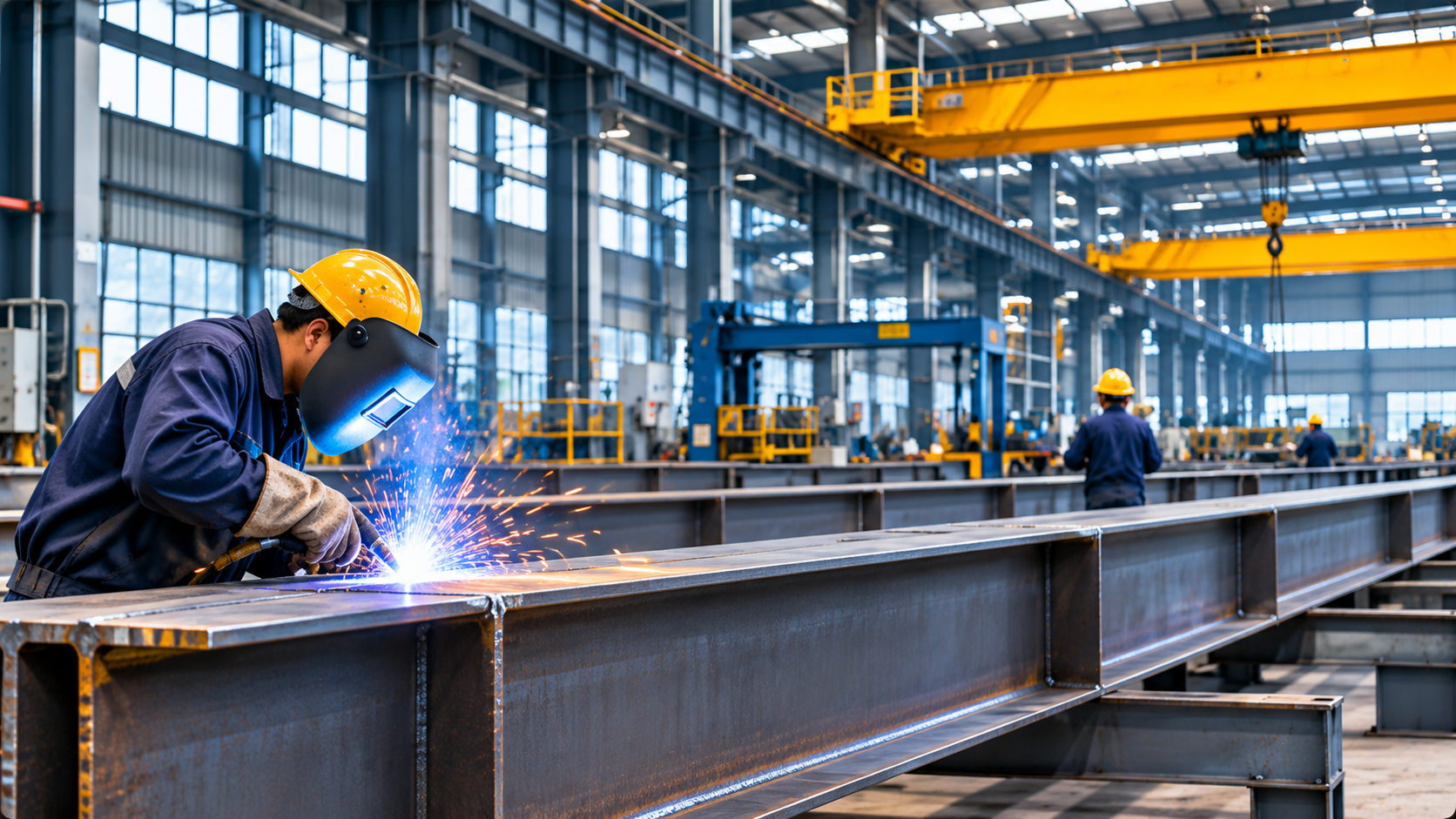
How to Choose a Structural Steel Fabricator in China: A Practical Buyer’s Guide
Choosing a structural steel fabricator in China involves much more than finding a competitive price per ton. For international contractors, EPC companies, developers and procurement teams, the right fabrication partner must also meet technical requirements, demonstrate reliable quality control and support the project’s delivery schedule.
China has an extensive structural steel manufacturing supply chain, with fabricators serving industrial buildings, warehouses, commercial developments and infrastructure projects. However, manufacturing capabilities, quality systems, engineering support and export experience can vary significantly between suppliers.
This guide explains how to evaluate a structural steel fabricator in China and what overseas buyers should verify before placing an order.
How to Choose a Structural Steel Fabricator in China: Quick Answer
To choose a structural steel fabricator in China, first define your project’s technical requirements, scope of supply, quality standards and delivery expectations. Shortlist manufacturers based on relevant project experience, actual fabrication capabilities and verifiable quality systems rather than price or advertised production capacity alone.
Before selecting a supplier, review its material traceability procedures, welding qualifications, inspection arrangements, technical communication process and export experience. Compare quotations using the same scope, quantity basis, surface treatment, packaging and delivery terms. Finally, confirm responsibilities for drawings, quality documentation, production milestones and changes before placing an order.
1. Define Your Project Requirements Before Contacting Fabricators
A successful sourcing process begins with a clear understanding of the project rather than a list of potential suppliers.
Before requesting quotations, buyers should identify the intended scope of supply, applicable standards and available technical documentation.
Important information typically includes:
- Project location and intended building use
- Structural drawings, specifications and available BIM or CAD models
- Applicable design, fabrication and inspection standards
- Required steel grades, member types and estimated quantities
- Welding, bolting and connection requirements
- Surface treatment, painting, galvanizing or fire protection requirements
- Required delivery schedule and destination
- Whether connection design, shop detailing or installation support is included
Not every manufacturer offers the same engineering services. Some companies fabricate steel based on approved shop drawings, while others provide detailing or limited engineering support.
Buyers should distinguish between structural design responsibility, connection design, detailing and fabrication. Any engineering services must be clearly defined and reviewed by appropriately qualified professionals.
A well-prepared request for quotation reduces misunderstandings and makes supplier proposals easier to compare.
2. Evaluate Actual Fabrication Capabilities
A manufacturer’s stated annual production capacity can provide useful background, but it does not necessarily indicate how much capacity is available for your project.
Buyers should investigate the factory’s equipment, production processes, workforce and current workload.
Key Manufacturing Capabilities to Review
Steel cutting and preparation: Can the factory process the required plate thicknesses, profiles and dimensions?
Assembly and welding: Does it have appropriate assembly lines, welding equipment and procedures for the project?
Component handling: Can cranes, lifting equipment and workshops accommodate the longest or heaviest members?
Surface treatment: Are blasting, painting and galvanizing performed in-house or subcontracted?
Production scheduling: What capacity is available during the proposed manufacturing period?
For large warehouses or industrial projects, the ability to manufacture repetitive beams and columns efficiently may be important. For complex structures, dimensional control, assembly planning and experience with nonstandard connections may matter more.
Ask manufacturers to explain how they would arrange production for your specific project rather than relying solely on a company brochure.
3. Review Relevant Project Experience
A portfolio containing large or visually impressive projects does not automatically prove that a fabricator is suitable for your requirements.
Request examples of completed work with similar technical and logistical characteristics.
For instance, a manufacturer supplying a warehouse project may have relevant experience with built-up steel columns, roof beams, bracing systems and connection assemblies.
A project involving complex geometry may require different fabrication and dimensional-control capabilities.
Useful questions include:
- What structural systems were involved?
- Which steel grades and fabrication standards were specified?
- What was the approximate supply quantity?
- Which quality inspections were required?
- Was the steel delivered domestically or exported?
- What challenges occurred during manufacturing or shipment?
When possible, request supporting information such as project photographs, sample inspection records or references that the supplier is authorized to share.
The objective is not simply to confirm that the manufacturer has completed projects. It is to understand whether its previous experience is relevant to yours.
4. Verify Standards and Certification Claims
International structural steel projects may refer to American, European or other regional standards.
However, claiming familiarity with a standard is not the same as demonstrating the ability to manufacture and document compliant products.
American Standards
Depending on the project, specifications may reference AISC requirements, ASTM material standards and AWS welding standards.
If AISC certification is required, buyers should verify the company’s current certification status and applicable scope through the American Institute of Steel Construction (AISC).
A certification should not be treated as automatic confirmation that every project-specific material, connection, coating or inspection requirement has been satisfied.
European Standards
European projects may specify EN material and execution requirements, including EN 1090 where applicable.
Buyers should clarify the relevant execution class, material documentation, welding requirements and conformity assessment obligations.
Welding Quality Requirements
The ISO 3834 series provides a framework for quality requirements associated with fusion welding of metallic materials.
Regardless of which standards apply, request evidence that the manufacturer has appropriate procedures, personnel, equipment and inspection arrangements.
The governing project documents, destination-country regulations and contractual requirements should determine the final compliance obligations.
5. Examine Material Traceability and Quality Documentation
A competitive quotation has limited value if the manufacturer cannot demonstrate control over the materials and fabrication processes used.
For structural steel, buyers should establish the required documentation before production begins.
Material Verification
Depending on the project, relevant records may include:
- Material Test Certificates (MTCs)
- Steel grade and heat-number identification
- Purchasing and receiving inspection records
- Traceability between raw materials and fabricated components
- Records of material substitutions and approvals
Not all projects require the same traceability system. The level of documentation should reflect the contract, applicable standards and project risk.
Welding Documentation
Where required, review Welding Procedure Specifications (WPS), supporting procedure qualification records (PQR/WPQR) and welder qualification evidence.
These documents should correspond to the materials, joint configurations, welding processes and other essential variables relevant to the project.
Inspection and Testing
Inspection requirements may include visual testing (VT), ultrasonic testing (UT), magnetic particle testing (MT) or penetrant testing (PT).
The inspection methods, acceptance criteria, coverage and reporting requirements should be agreed before manufacturing.
Buyers should also clarify whether inspection is performed internally, by an independent third party or through both arrangements.
Quality documentation is most useful when it demonstrates a controlled process rather than simply providing a collection of certificates at the end of production.
For additional background, see our Structural Steel Quality & Standards Guide.
6. Assess Technical Communication and Project Management
International projects often involve several parties: the owner, structural engineer, general contractor, steel fabricator, inspection company and logistics provider.
Poor technical communication can create problems even when manufacturing equipment and material quality are adequate.
Before placing an order, consider how the supplier manages:
Requests for Information (RFIs): Is there a documented process for raising technical questions?
Drawing revisions: How are updated drawings distributed, reviewed and controlled?
Shop drawing approval: Who prepares the drawings, and who is responsible for approval before fabrication?
Change management: How are scope changes, additional quantities and revised delivery dates handled?
Progress reporting: Will the supplier provide clear manufacturing milestones and production updates?
A reliable process should identify responsible contacts, document decisions and prevent unapproved changes from entering production.
For overseas buyers, structured written communication can be particularly valuable when technical discussions involve different languages and time zones.
7. Compare Quotations on an Equivalent Basis
The lowest quoted price per ton is not necessarily the lowest overall project cost.
One supplier may include connection plates, bolts, coating, packaging and inspection, while another may quote only the primary fabricated steel members.
Before comparing prices, confirm that each supplier is quoting the same scope and assumptions.
Important Commercial Items
Supply scope: Are primary members, secondary members, connection components, bolts and accessories included?
Quantity basis: Is the price calculated using an estimated bill of quantities, approved shop drawings or actual fabricated weight?
Fabrication scope: Are cutting, welding, drilling, assembly and shop detailing included?
Surface protection: Are coating materials, surface preparation, galvanizing and inspection included?
Quality requirements: Are required testing, documentation and third-party inspection costs included?
Packaging: Are shipping frames, protective materials, identification and loading included?
Delivery terms: Is the quotation based on EXW, FOB, CIF, FCA or another agreed term?
The International Chamber of Commerce’s Incoterms® 2020 rules help clarify responsibilities for delivery, costs and risk between buyers and sellers. They do not replace the need for a complete sales contract.
Buyers should specify the named delivery location and the relevant Incoterms edition.
A consistent quotation comparison should identify exclusions, provisional items and technical assumptions before suppliers are shortlisted.
Explore our Structural Steel RFQ & Quotation Guide for further guidance.
Before requesting quotations, buyers should prepare a consistent set of drawings, technical requirements and scope documents. For practical guidance, read our step-by-step guide to preparing a structural steel RFQ for Chinese fabricators.
8. Plan Quality Inspections Before Production
Third-party inspection can provide additional assurance, particularly when buyers cannot visit the factory during every stage of manufacturing.
However, an inspection performed only before shipment may not reveal problems that occurred earlier in the production process.
Consider establishing inspection hold points appropriate to the project.
Potential stages include:
- Raw material receipt and identification
- Review of approved drawings and manufacturing procedures
- Welding and in-process dimensional inspection
- Required nondestructive testing
- Surface preparation and coating inspection
- Final dimensional and visual inspection
- Packing, marking and loading verification
The inspection and test plan should specify responsibilities, acceptance criteria, required records and the process for dealing with nonconforming work.
Any rework, repair or material replacement should follow the agreed technical requirements and approval procedures.
9. Evaluate Export Packaging and Logistics Experience
Fabricating acceptable steel components is only part of an international supply project.
Large structural members may create transportation challenges because of their length, weight, geometry or susceptibility to damage.
Before manufacturing begins, clarify whether individual components can be transported using standard containers or whether special equipment, breakbulk shipping or revised packaging arrangements may be necessary.
Important considerations include:
- Maximum dimensions and weights of fabricated members
- Loading and unloading arrangements
- Packaging frames and cargo securing
- Component markings and packing lists
- Protection of coatings and exposed surfaces
- Port restrictions and destination handling requirements
- Shipping documents and customs responsibilities
Where possible, the packaging and shipping strategy should influence fabrication planning from the beginning rather than being considered only after production is complete.
Read our Structural Steel Export & Logistics Guide for more information.
10. Watch for Common Supplier Selection Risks
Buyers should investigate warning signs rather than making decisions solely on price or presentation.
Examples include:
Unclear manufacturing responsibility: The company providing the quotation cannot clearly identify which factory will manufacture the steel.
Unsupported certification claims: Certificates are presented without adequate verification of their validity, scope or relevance.
Incomplete quotations: Important items such as connections, coatings, testing or packaging are excluded without explanation.
Uncontrolled technical changes: Drawing revisions and material substitutions are not documented or approved.
Unrealistic delivery promises: Lead times are offered without a credible production and logistics schedule.
Limited quality records: The supplier cannot explain its approach to material traceability, welding control or inspection documentation.
A supplier does not necessarily need to be the largest or most expensive manufacturer. It needs to demonstrate that its capabilities, management processes and commercial commitments are appropriate for the project.
Structural Steel Fabricator Evaluation Checklist
Before choosing a structural steel fabricator in China, consider confirming the following:
- The manufacturer has reviewed the project drawings and specifications.
- The required standards and scope of compliance are understood.
- Actual production capacity and delivery milestones have been discussed.
- Relevant project experience has been reviewed.
- Material procurement and traceability requirements are defined.
- Welding qualifications and inspection requirements are clarified.
- Responsibility for detailing and engineering is documented.
- The quotation includes a clear supply scope and list of exclusions.
- Packing, shipping and delivery responsibilities are established.
- Payment terms, variation procedures and contract conditions are understood.
Supporting Evidence to Request from a Structural Steel Fabricator
| Evaluation Area | Suggested Supporting Evidence |
|---|---|
| Factory Identity & Verification | Business license, registered company name, factory address, site visit or live video verification, and confirmation of the entity operating the facility. |
| Manufacturing Capability | Current equipment list, production capacity evidence, recent production records, factory photos and available production schedule. |
| Subcontracting & Production Control | Disclosure of outsourced fabrication, welding, coating or galvanizing activities, proposed production locations and relevant quality control arrangements. |
| Relevant Project Experience | Comparable project references and completed project records |
| Material Traceability | Sample Material Test Certificates (MTCs) and heat-number traceability records |
| Welding Quality | Applicable WPS, PQR and welder qualification records |
| Certification Verification | Relevant certificates and independent verification of their validity, issuing bodies, certified entities, facility locations and applicable certification scopes. |
| Quality Control | Inspection and Test Plan (ITP), sample inspection reports and applicable NDT records |
| Engineering and Detailing | Sample shop drawings, RFI procedures and defined design responsibilities |
| Commercial Transparency | Itemized quotation, scope of supply and exclusions |
| Export Readiness | Sample export packing plan, delivery terms and relevant shipping experience |
This checklist is a starting point, not a substitute for project-specific technical, commercial or legal due diligence.
Frequently Asked Questions
How can I verify whether a Chinese steel supplier is an actual manufacturer?
Ask for the supplier’s registered legal name, the name and address of the actual fabrication facility, and evidence of recent production activity, such as equipment records and completed project references.
Where practical, arrange a live video walkthrough, factory visit or independent audit to verify the manufacturing facility and its capabilities.
If the supplier is a trading company or uses subcontractors, confirm which factory will perform the fabrication and who is responsible for production, quality control, inspection documentation and delivery.
A trading company is not necessarily an unsuitable supplier. What matters is transparency, verified manufacturing capabilities and clearly defined contractual responsibilities.
Is AISC certification required for every structural steel project?
Not necessarily. Certification requirements depend on the project specifications, contractual obligations and applicable regulations. If AISC certification is required, verify the manufacturer’s current certification status and scope through the official AISC directory. Certification alone does not establish compliance with every project-specific material, welding or inspection requirement.
What should be agreed upon before steel fabrication begins?
Buyers and fabricators should confirm the approved drawing revisions, material specifications, scope of supply, technical responsibilities, inspection requirements and production schedule. Required welding documentation, material traceability procedures and inspection hold points should also be agreed where applicable. Changes should follow a documented approval process.
How should overseas buyers compare steel fabrication quotations?
Compare quotations using the same technical specifications, supply scope, quantity basis and delivery terms. Check whether connection plates, bolts, coatings, inspections, documentation and export packaging are included. A lower price per ton may not represent a lower total procurement cost when important items are excluded.
Final Thoughts
Selecting a structural steel fabricator in China should be a structured evaluation process rather than a simple price comparison.
Manufacturing capability, relevant experience, quality systems, technical communication, commercial transparency and delivery planning all contribute to a successful international procurement project.
For overseas buyers, asking the right questions before signing a contract can help reduce misunderstandings and create a clearer basis for working with potential manufacturing partners.
Before requesting quotations, review our guide to preparing a structural steel RFQ to clarify drawings, scope of supply and commercial terms. For material specifications, welding, inspection and documentation requirements, explore our Structural Steel Quality & Standards guide.
About SteelSourcing Compass
SteelSourcing Compass is an independent information and industry networking platform sharing practical knowledge about structural steel sourcing, fabrication, quality standards and international procurement.
If you are evaluating sourcing options or preparing a structural steel project inquiry, contact SteelSourcing Compass to discuss your requirements and explore potential industry connections.
