How to Prepare a Structural Steel RFQ for Chinese Fabricators
A well-prepared structural steel RFQ (Request for Quotation) helps international buyers obtain more accurate quotations, compare fabrication suppliers and reduce the risk of misunderstandings before production begins.
For warehouses, industrial buildings, commercial facilities and other steel construction projects, requesting a price per ton is rarely enough. Two fabricators may quote the same project at very different prices because they have interpreted the drawings, scope of supply, quality requirements or delivery responsibilities differently.
This guide explains how to prepare a practical structural steel RFQ for Chinese fabricators, which documents to provide and what to check before comparing quotations.
What Should a Structural Steel RFQ Include?
A structural steel RFQ (Request for Quotation) should include project information, structural drawings with revision status, material specifications, scope of supply, estimated quantities, fabrication and quality requirements, surface protection, delivery schedule, and shipping terms.
For international procurement, buyers should also clarify the pricing basis (such as EXW, FOB or CIF), required inspection documents, packaging requirements, destination and commercial conditions. Any incomplete drawings, provisional quantities or exclusions should be clearly identified so that suppliers can state their assumptions and provide comparable quotations.
1. Start with the Project Basics
Before approaching steel fabricators, prepare a short project information sheet.
At minimum, identify:
- Project name and location: Country, city and intended construction site.
- Building type: Warehouse, factory, logistics facility, commercial building or other structure.
- Approximate dimensions: Building length, width, height, number of floors and major spans, if available.
- Estimated steel quantity: State whether the tonnage comes from a detailed bill of quantities, preliminary structural model or early budget estimate.
- Project stage: Concept design, preliminary design, tender, issued for construction or another documented status.
- Expected delivery: Required shipment period and any phased-delivery requirements.
- Buyer’s requested scope: Supply of fabricated structural steel only, or additional materials and services.
These details help the supplier understand the scale and maturity of the project.
If the structural design has not been completed, clearly request a budgetary quotation rather than presenting the inquiry as a final manufacturing order.
A preliminary price can support feasibility studies, but it should not be treated as a firm quotation based on approved construction documents.
2. Provide Drawings and Identify Their Revision Status
Structural drawings are among the most important documents in a fabrication RFQ.
Useful documents may include:
- General arrangement drawings, framing plans and elevations.
- Structural member schedules and steel grades.
- Connection details and available connection design information.
- Anchor bolt layouts and foundation interface details.
- Sections showing critical dimensions and building geometry.
- A bill of quantities or material take-off, where available.
- Project specifications and relevant design requirements.
Whenever possible, provide readable PDFs together with relevant CAD or model files. State which documents govern in the event of differences between file formats.
Always include drawing numbers, revision identifiers and issue dates.
For example, if one bidder receives Revision A while another uses Revision C, the resulting prices may not be comparable.
The RFQ should also define responsibilities for structural design, connection design, shop detailing, drawing approval and resolution of technical questions. These activities should not be assumed to be included in the fabrication price.
What if the drawings are incomplete?
Incomplete drawings do not necessarily prevent a preliminary quotation.
However, the buyer should ask suppliers to identify:
- Assumptions used for estimating steel quantities.
- Missing information required for a firm price.
- Provisional material grades or connection assumptions.
- Engineering and detailing services included or excluded.
- Potential price adjustments after design development.
A written assumptions register makes later revisions easier to manage.
3. Define the Structural Steel Scope of Supply
One of the biggest sources of quotation differences is an unclear supply boundary.
A quotation described simply as “structural steel supply” may cover different items depending on the supplier and project.
Before sending the RFQ, decide which components are included, excluded or optional.
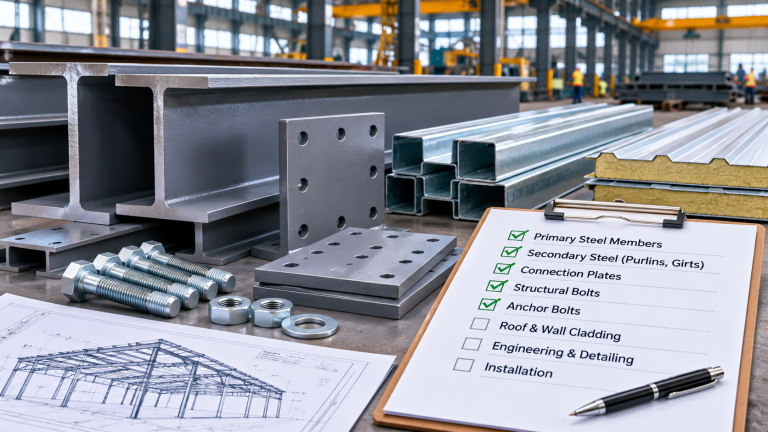
Structural components to clarify
| Component | Question for the RFQ |
|---|---|
| Primary columns and beams | Are all main structural members included? |
| Bracing and secondary steel | Are braces, purlins, girts and secondary members included? |
| Connection plates | Are base plates, splice plates, stiffeners and other connection components included? |
| Structural bolts | Are bolts, nuts, washers and spare quantities included? |
| Anchor bolts | Are anchors, templates and associated accessories included? |
| Roof and wall systems | Are cladding, roof sheets, flashings and related accessories included? |
| Other steel items | Are stairs, platforms, ladders, rails and miscellaneous steel included? |
| Site installation | Is erection excluded, included or separately priced? |
Not every structural steel project requires all these items.
The important point is to ensure that every bidder uses the same scope boundary.
Where possible, request a separate price for optional materials, rather than combining everything into a single total.
A clearly defined supply scope is essential for comparing structural steel quotations on an equivalent basis. For a detailed breakdown of structural members, connection plates, bolts, cladding and common exclusions, see our structural steel scope of supply checklist.
4. Specify Materials and Applicable Standards
The RFQ should identify the material specifications and fabrication requirements applicable to the project.
For example, a project may reference relevant ASTM specifications and AISC requirements, while another may specify European material grades and execution requirements.
Do not assume that materials commonly available in China are automatically interchangeable with the specified overseas grades.
The buyer should identify:
- Required material standards, grades and product forms.
- Any requirements for hollow structural sections, plates or rolled sections.
- Applicable structural steel fabrication or execution standards.
- Welding requirements and qualification documentation.
- Dimensional tolerances and inspection requirements.
- Material certificate and traceability expectations.
For European-standard projects, the RFQ may need to address relevant EN requirements, including execution and material documentation, as applicable.
A supplier’s statement that it can work to a standard is not the same as verified certification or demonstrated project compliance.
When certification is contractually required, ask for the specific certificate, its scope, validity and the entity covered.
Also request written confirmation before accepting proposed alternative steel grades or equivalent materials.
5. Clarify Welding, Inspection and Quality Documentation
A low fabrication price may become less attractive when the project requires additional testing, documentation or third-party inspection.
The RFQ should clearly state what quality activities are expected.
Depending on the project, relevant items may include:
- Material test reports or mill test certificates.
- Material identification and traceability records.
- Welding Procedure Specifications (WPS) and supporting qualification records.
- Welder qualification records, where required.
- Visual inspection and specified nondestructive testing.
- Dimensional inspections and assembly checks.
- Coating or galvanizing inspection records.
- Final release documentation before shipment.
If third-party inspection is required, define the inspection agency’s role, the proposed inspection stages, notification periods and who bears the associated costs.
Avoid requesting unspecified “100% inspection”
An RFQ stating only “100% NDT required” can create confusion and unnecessary cost.
Different weld types and project standards may require different inspection methods and acceptance criteria.
The project’s responsible engineering and quality personnel should establish the applicable inspection scope and requirements. The fabricator should then quote against those defined requirements.
6. Specify Surface Protection Requirements
Surface treatment can materially influence fabrication cost, lead time, packing and transportation.
Instead of writing only “painted” or “galvanized,” define the required system.
For painted steel, clarify:
- Surface preparation requirements.
- Primer and coating system.
- Required dry film thickness, where specified.
- Areas requiring masking or special treatment.
- Coating inspection and repair requirements.
For hot-dip galvanized steel, identify the applicable specification, the components requiring galvanizing and any relevant detailing or post-galvanizing requirements.
Also clarify whether fire-protection treatment is part of the fabrication package, handled by another contractor or excluded from the order.
A quotation should identify these assumptions rather than leave them implicit.
7. Confirm the Quantity and Pricing Basis
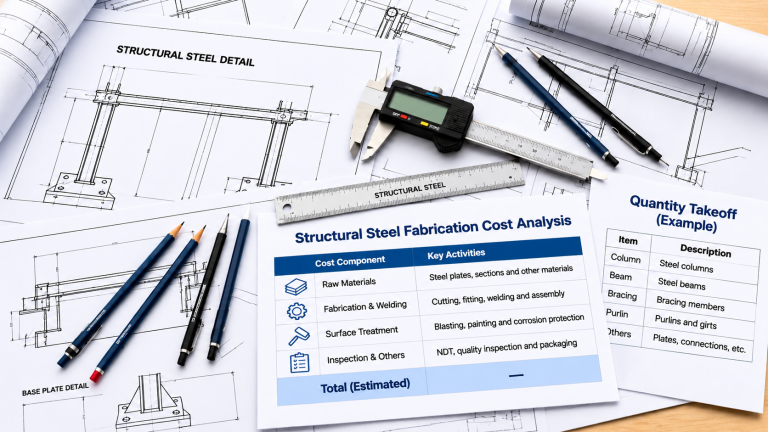
Structural steel quotations are often presented as a price per metric ton. However, the underlying quantity and cost components may differ.
A buyer should ask the supplier to state whether the quoted tonnage represents:
- An estimate based on preliminary drawings.
- Calculated net steel weight from a bill of quantities.
- A defined fabrication or contractual measurement basis.
- Another specifically agreed weight calculation method.
Also clarify how connection plates, fabrication allowances, bolts, coatings, packaging and additional components are priced.
For commercial comparison, request the following breakdown where practical:
| Price Item | Quotation Requirement |
|---|---|
| Structural steel material | Identify applicable grade and pricing basis |
| Fabrication | Identify what manufacturing operations are included |
| Surface treatment | Separate or clearly identify coating/galvanizing costs |
| Bolts and accessories | Confirm inclusion and quantities |
| Engineering and detailing | State the included scope or separate fee |
| Quality inspection | Identify included and separately charged services |
| Packing and loading | Clarify responsibilities and costs |
| Transportation | Identify the agreed delivery term and destination |
The lowest price per ton is not necessarily the lowest total project cost.
A more reliable comparison considers the complete scope, technical compliance, delivery responsibilities and documented exclusions.
8. Define Packing, Shipping and Delivery Terms
Fabricated steel members can be long, heavy or irregularly shaped. Shipping arrangements should therefore be considered before the quotation is finalized.
Include the following information in the RFQ:
- Destination country and named place or port.
- Expected shipment period.
- Whether delivery is required in one shipment or multiple phases.
- Any container size or transport restrictions.
- Requirements for piece marking, bundling and packing lists.
- Whether loading, securing and transport frames are included.
- Any special unloading or site delivery requirements.
For the commercial terms, identify the specific Incoterms® 2020 rule and the named location.
For example, instead of stating only “FCA,” specify the agreed delivery location and the applicable version of the rules.
For containerized cargo, consider whether FCA, CPT or CIP better reflects the actual transport arrangements. Traditional maritime terms such as FOB and CIF are not automatically the most suitable choice for every container movement.
The RFQ should also identify the expected shipping documents and which party will handle destination customs, local transportation and unloading.
9. Request a Clear Delivery Schedule
Steel fabrication lead time depends on more than workshop production capacity.
Important factors may include material procurement, drawing approval, manufacturing, inspection, coating, packing and transportation.
Ask suppliers to provide a preliminary schedule showing:
- Technical clarification and drawing approval.
- Material procurement.
- Shop fabrication.
- Inspection and surface treatment.
- Packing and readiness for dispatch.
- Estimated shipment date.
If the project needs staggered deliveries, ask whether the supplier can arrange fabrication and packing according to the proposed erection sequence.
Any delivery estimate should identify its assumptions and the point from which the schedule starts.
10. Require Suppliers to List Assumptions and Exclusions
A useful quotation does more than state a total price.
It should explain what the supplier has assumed and identify requirements that have not been priced.
Ask each fabricator to provide:
- A clearly defined scope of supply.
- Itemized pricing or a suitable commercial breakdown.
- Quoted quantity and measurement basis.
- Applicable technical standards and material specifications.
- Planned quality documentation and inspection scope.
- Surface protection assumptions.
- Proposed delivery schedule.
- Incoterms® rule and named delivery place.
- Payment terms and price validity period.
- Technical deviations, assumptions and exclusions.
These details help buyers compare quotations on an equivalent basis and reduce the risk of unexpected costs after contract award.
Practical Structural Steel RFQ Checklist
Before sending your inquiry, check that you can answer these questions:
- Have we identified the project location, purpose and current design stage?
- Have we supplied the latest available drawings and clearly identified their revisions?
- Have we defined whether the quotation is budgetary or firm?
- Have we listed the structural components and accessories to be supplied?
- Have we identified the applicable materials and technical standards?
- Have we defined responsibility for connection design, detailing and drawing approval?
- Have we specified welding, quality and inspection requirements?
- Have we identified the surface protection requirements?
- Have we defined the quotation quantity, pricing currency, pricing method (unit rate or lump sum), and measurement and settlement basis?
- Have we specified packing requirements, the delivery destination, and the applicable Incoterms rule with a named place and version?
- Have we requested a delivery schedule, quotation validity period, and quotation submission deadline?
- Have we asked suppliers to disclose assumptions, exclusions and deviations?
- Have we clarified the proposed payment terms and any required payment security arrangements?
An RFQ does not need to answer every technical question at the first inquiry stage. However, unresolved items should be identified rather than hidden.
Sample Email: Request for Structural Steel Fabrication Quotation
Subject: RFQ – Structural Steel Fabrication for [Project Name] – [Country]
Dear [Supplier Name],
We are currently evaluating potential fabrication suppliers for a structural steel project in [Project Location].
Please review the attached project information and provide a quotation based on the available drawings and the following requirements.
Project information
- Project name: [Project Name]
- Project location: [City, Country]
- Building type: [Warehouse / Industrial Facility / Other]
- Estimated steel quantity: [XX metric tons]
- Drawing status and revision: [Details]
- Applicable standards: [Details]
- Required scope of supply: [Details]
- Surface treatment: [Details]
- Inspection and documentation: [Details]
- Requested delivery term and location: [Details]
- Target delivery schedule: [Details]
- Documents attached: [Drawing list and revisions / BOQ / Technical specifications]
- Pricing and quantity basis: [Currency, price per metric ton or lump sum, and theoretical or actual weight basis]
- Quotation submission deadline: [Date]
Please include your pricing breakdown, estimated lead time, quotation validity, payment terms, exclusions and any technical assumptions.
If additional information is needed to prepare a reliable quotation, please provide a list of clarification questions.
We look forward to reviewing your proposal.
Best regards,
[Name]
[Company]
[Contact Information]
Common Questions About Structural Steel RFQs
Can I request a quotation without completed fabrication drawings?
Yes. A preliminary or budgetary quotation may be possible using general arrangement drawings, structural information and a clearly identified set of assumptions. However, a firm fabrication price usually requires more complete technical information.
Is a steel price per ton enough to compare suppliers?
No. Buyers should also compare quantity calculations, accessories, engineering responsibilities, surface protection, inspection, packaging, delivery terms and exclusions.
Should I send the same RFQ package to every supplier?
Ideally, yes. Using the same document revisions and scope assumptions creates a more consistent basis for comparison. Clarifications and revisions should also be shared with relevant bidders.
Does a Chinese fabricator automatically provide structural engineering design?
No. Engineering design, connection design, shop detailing and fabrication are distinct responsibilities. The RFQ and contract should explicitly define which party performs and approves each activity.
Final Thoughts
Preparing a structural steel RFQ is not simply about requesting the lowest manufacturing price.
It is about giving potential suppliers enough information to understand the project, define the work they are pricing and identify the technical and commercial risks that remain unresolved.
A clear RFQ improves communication, supports more meaningful quotation comparisons and provides a stronger foundation for subsequent purchasing decisions.
Before preparing an RFQ, buyers should also evaluate potential suppliers’ manufacturing capabilities, quality systems and relevant project experience. For more guidance, read our practical guide on how to choose a structural steel fabricator in China.
At SteelSourcing Compass, we share independent structural steel sourcing insights to help international buyers better understand fabrication, supplier evaluation and cross-border procurement.
Explore our RFQ & Quotation Guide, Quality & Standards resources and Export & Logistics Guide for related information.
Preparing a structural steel RFQ? Contact SteelSourcing Compass to discuss your project requirements and sourcing questions. To help us understand your inquiry, please include the project location, estimated steel quantity, available drawing status and target delivery schedule.
Information note: This article provides general procurement guidance. Project-specific engineering, code compliance, certification requirements and contractual responsibilities should be confirmed with appropriately qualified professionals and the relevant project parties.