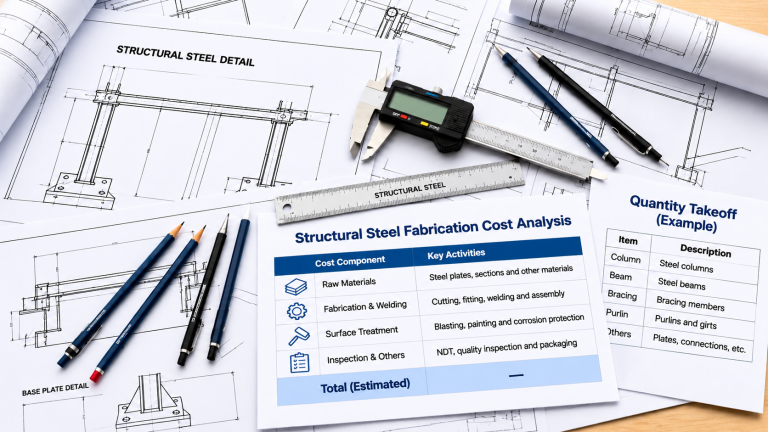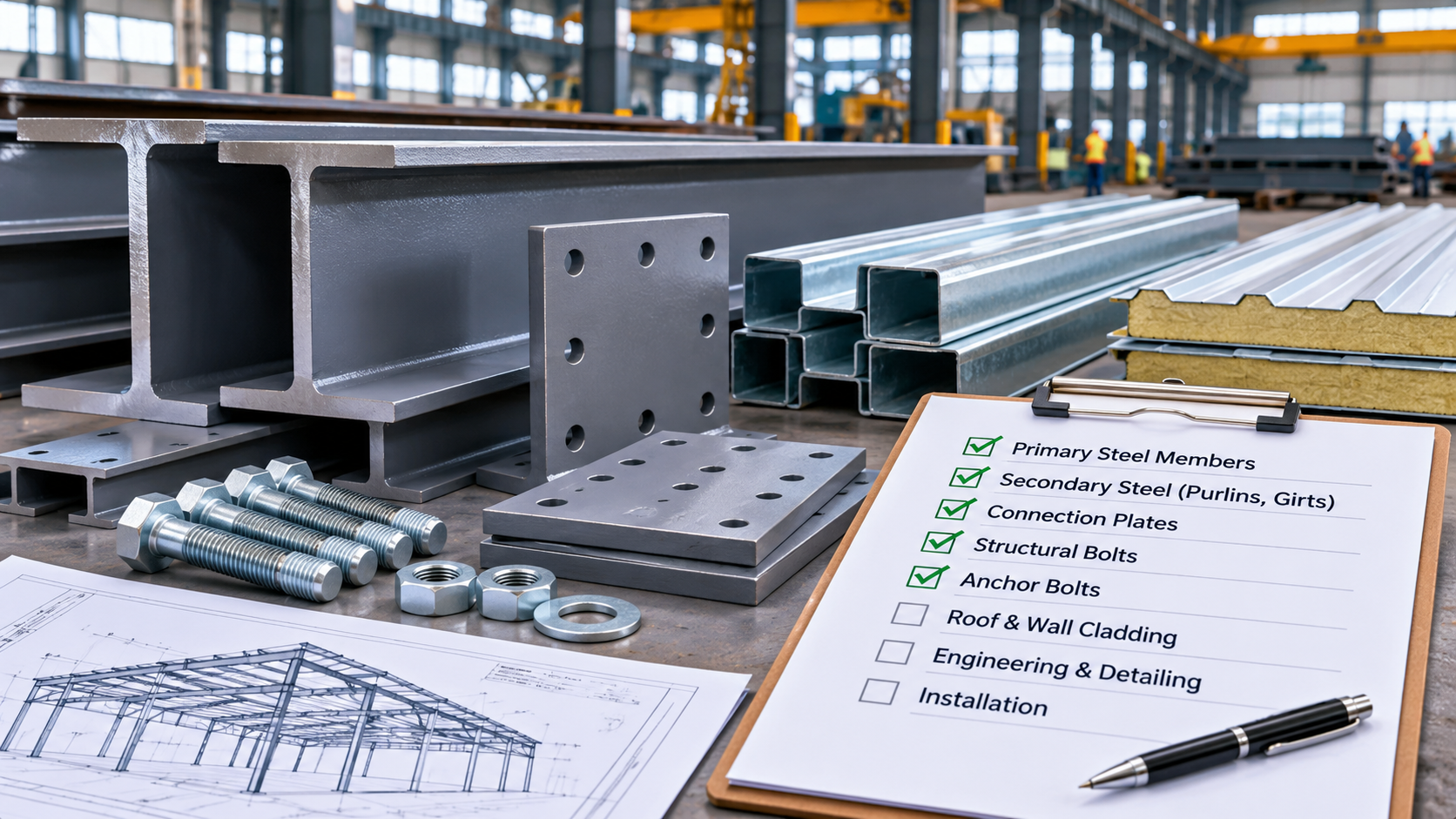
Structural Steel Scope of Supply Checklist: What’s Included and Excluded?
When international buyers request quotations for fabricated structural steel, comparing prices per metric ton may seem straightforward.
However, two suppliers quoting the same warehouse or industrial building may be pricing very different packages.
One quotation may cover only the primary steel columns and beams. Another may include secondary framing, connection plates, bolts, protective coatings and export packaging.
Even when both suppliers describe their quotations as “structural steel supply,” the actual deliverables may be significantly different.
This is why defining the structural steel scope of supply is one of the most important steps in international steel procurement.
This guide explains what buyers should check, which items are commonly excluded and how to prepare a consistent scope of supply checklist before comparing quotations from Chinese steel fabricators.
1. What Does Scope of Supply Mean in Structural Steel Procurement?
The scope of supply defines the products, materials, documents and services that a supplier is contractually required to provide.
It should answer three basic questions:
- What exactly will the supplier deliver?
- Which activities and materials are excluded?
- Who is responsible for the remaining work?
A scope of supply may include fabricated steel members only, or a wider package covering steel accessories, protective coatings, engineering services and shipping arrangements.
The scope of supply is related to, but not always identical to, the scope of work.
For example, a supplier may provide fabricated beams, columns and bolts without being responsible for on-site installation. A separate erection contractor may then handle unloading, lifting, assembly, alignment and field bolting.
The buyer should distinguish between the supply of materials and the performance of construction services.
The quotation, bill of quantities and contract documents should consistently reflect these boundaries.
2. Define the Primary and Secondary Structural Steel
The first step is to identify which steel members are included in the fabrication package.
Primary structural steel
Depending on the project, the primary structural frame may include:
- Steel columns.
- Main beams and girders.
- Portal frames and rigid frames.
- Structural trusses.
- Major bracing members.
- Other specifically identified load-bearing steel members.
Secondary structural steel
Secondary components may include:
- Roof purlins.
- Wall girts.
- Eave struts.
- Sag rods and bridging.
- Secondary bracing.
- Framing around doors and openings.
- Miscellaneous secondary support members.
Do not assume that every supplier automatically includes secondary framing in a quotation for the primary steel structure.
Some fabricators price hot-rolled primary steel separately from cold-formed members. Others may obtain purlins, girts or specialized components from subcontractors.
Buyer recommendation: Request separate quantities for primary and secondary steel wherever practical.
This helps buyers identify missing items and understand how different component groups contribute to the total price.
3. Clarify Connection Plates, Bolts and Anchor Bolts
Connection components are among the most frequently overlooked items in a structural steel quotation.
A supplier may include connection plates welded to steel members but exclude loose connection plates, site bolts or foundation anchors.
Connection plates
Confirm whether the quotation includes:
- Base plates.
- End plates and splice plates.
- Gusset plates.
- Stiffeners.
- Connection angles and brackets.
- Loose connection components.
Also clarify whether connection plates are already included in the quoted fabricated steel weight.
Structural bolts
Do not simply state “all bolts included.”
The RFQ should identify:
- Applicable bolt specifications and grades.
- Required sizes and quantities.
- Nuts and washers.
- Coating or corrosion protection requirements.
- Any specified spare quantities.
- Responsibility for supply and installation.
Anchor bolts
Foundation anchor bolts deserve separate attention.
In some projects, the civil contractor supplies and installs the anchor rods. In others, the steel supplier provides them while the civil contractor handles installation.
Buyers should clarify responsibility for:
- Anchor rods and associated nuts and washers.
- Anchor templates.
- Setting drawings or information.
- Delivery timing ahead of foundation construction.
- Installation, positioning and verification.
Providing the anchors does not automatically mean that the supplier is responsible for their installation or the foundation design.
4. Identify Roof, Wall and Building Envelope Items
A structural steel frame is not the same as a complete enclosed building.
A fabricator may quote the bare structural frame while another supplier includes roofing, wall cladding and related accessories.
The RFQ should clearly identify whether the following are included:
| Component | What the Buyer Should Check |
|---|---|
| Roof panels | Profile, material, thickness, coating and insulation |
| Wall cladding | Panel type, finish and required performance |
| Insulated sandwich panels | Insulation material, thickness and panel specification |
| Roof and wall flashings | Ridge caps, corner trims, closures and edge details |
| Rainwater system | Gutters, downpipes and accessories |
| Fasteners and sealants | Screws, rivets, sealants and weatherproofing materials |
| Doors and windows | Frames, hardware, opening dimensions and supply responsibility |
| Skylights and ventilation | Rooflights, vents, louvers and associated framing |
A quotation that excludes cladding should not be compared directly with one that includes a complete roof and wall package.
Buyers should also confirm whether the supplier is quoting only the supply of panels or their installation as well.
For building envelope systems, technical performance requirements and the applicable project specifications must be defined separately.
5. Separate Engineering Design, Detailing and Fabrication
Engineering responsibilities are often unclear when an overseas contractor purchases fabricated structural steel from China.
Several activities must be distinguished.
Structural engineering design
This typically concerns the structural system, loads, member design and overall engineering requirements.
The responsible design professional and approval arrangements should be identified by the project.
Connection design
Connection design may involve bolts, welds, plates and connection configurations.
The RFQ should state whether connection design is provided by the engineer of record, delegated to another qualified professional or included within an agreed supplier-related scope.
Shop detailing
Shop detailing translates the relevant design information into fabrication drawings, piece marks and production information.
Buyers should confirm whether shop detailing, revisions and drawing coordination are included in the quotation.
Drawing approval
Define who will review and approve fabrication drawings and how technical clarifications or design changes will be handled.
Important: A steel fabrication supplier should not automatically be assumed to provide licensed structural design or local engineering approval.
Responsibilities must be agreed in writing and must comply with applicable project and jurisdictional requirements.
6. Confirm Surface Treatment and Fire Protection
Surface protection may represent a significant part of the cost, especially for projects involving hot-dip galvanizing or multi-coat protective paint systems.
Common surface treatment options
- Shop primer.
- Specified protective paint systems.
- Hot-dip galvanizing.
- Other project-specific protective treatments.
The quotation should identify the required surface preparation, coating system, relevant inspection requirements and any touch-up or repair responsibilities.
If a project specifies hot-dip galvanizing, clarify which components are to be galvanized, including whether bolts and secondary members require separate treatment.
Also establish whether passive fire protection, fireproof coatings or other fire-resistance measures are included or excluded.
These should not be assumed to be covered by a generic “steel fabrication price.”
7. Define Quality Inspection and Documentation
A complete steel fabrication package may involve material documentation, welding quality control, dimensional inspections and shipping records.
Depending on the project requirements, the buyer may request:
- Material test reports or mill test certificates.
- Material identification and traceability records.
- Welding procedure documentation.
- Welder qualification documentation.
- Visual inspection records.
- Specified nondestructive testing reports.
- Dimensional inspection records.
- Surface treatment inspection records.
- Final packing lists and piece-mark information.
The RFQ should specify which documents are required, when they must be submitted and whether they are included in the supplier’s price.
Third-party inspection
If the buyer requires an independent inspection agency, the quotation should clarify who arranges and pays for inspection.
The parties should also agree on relevant inspection stages and notification requirements.
An inspection requirement added after the quotation has been accepted may increase cost or affect production and dispatch schedules.
8. Understand the Structural Steel Weight and Pricing Basis
For international steel procurement, the quoted price per metric ton is meaningful only when the measurement basis is clear.
Possible quantity bases include:
- A preliminary steel weight estimate.
- A calculated bill of quantities.
- The defined contractual weight of fabricated components.
- Another agreed measurement method.
Buyers should establish whether the weight includes connection plates, stiffeners and miscellaneous fabricated steel.
Other items such as bolts, purlins, roof panels, protective coatings and shipping frames may be priced separately.
Ask whether the quotation is based on:
- A fixed total price for an agreed scope.
- A unit price applied to defined quantities.
- An agreed actual-weight measurement method.
- Another clearly specified contractual pricing mechanism.
There is no single weight measurement rule that should be assumed to apply to every international structural steel contract.
The agreement should address how additions, deletions, drawing revisions and quantity changes affect the final price.
Why the lowest price per ton may be misleading
Consider two hypothetical quotations for the same industrial building.
Supplier A offers a lower unit price but excludes structural bolts, anchor rods, galvanizing and export packing.
Supplier B offers a higher unit price but includes the agreed structural connections, specified corrosion protection and export packing.
Supplier A is not necessarily the lower-cost option.
The buyer must first add the cost of excluded components and services and compare both offers against the same defined scope.
This process is commonly described as comparing quotations on a like-for-like basis.
9. Clarify Export Packing and Delivery Responsibilities
The scope of supply should not end at the factory gate without clearly addressing delivery.
Fabricated structural steel often requires specific packing and handling arrangements due to member dimensions, weight and loading limitations.
Check whether the supplier’s quotation includes:
- Piece marking and identification labels.
- Bundling and protective packing.
- Steel packing frames or transportation supports.
- Loading at the supplier’s facility.
- Container loading and cargo securing.
- Packing lists and relevant shipping documentation.
- Inland transportation to the named departure point.
- Ocean freight, if agreed.
- Delivery to the named destination, if agreed.
The parties should use the selected Incoterms® rule with a clearly named place or port and the applicable edition, such as Incoterms® 2020.
Incoterms® rules help allocate transportation-related obligations, costs and risks. They do not, by themselves, define fabrication quality requirements, engineering services or site erection responsibilities.
For further guidance, see our Export & Logistics Guide.
10. Make Site Installation Exclusions Explicit
Fabrication and on-site erection are different activities.
When purchasing a supply-only structural steel package, buyers should verify whether the quotation excludes:
- Site unloading.
- Temporary storage.
- Cranes and lifting equipment.
- On-site installation labor.
- Field bolting and field welding.
- Temporary bracing and erection supports.
- Site safety arrangements.
- Scaffolding or access equipment.
- Foundation and concrete works.
- Grouting and other civil interfaces.
- Field coating repairs.
- Final site inspections and acceptance activities.
Some of these responsibilities may be allocated to a local erection contractor, civil contractor or another project participant.
The correct allocation depends on the project contract and applicable local requirements.
Buyer recommendation: Ask each supplier to provide a written exclusion list rather than rely on informal assumptions about “standard” supply-only work.
11. Structural Steel Scope of Supply Checklist
Before accepting a quotation, use the following matrix to identify the required scope.
The status for each line should be specified as Included, Excluded, By Others or To Be Clarified.
| Scope Item | What to Confirm |
|---|---|
| Primary structural members | Members, grade, quantity and fabrication scope |
| Secondary steel | Purlins, girts, bracing and miscellaneous supports |
| Connection plates | Welded and loose plates, stiffeners and brackets |
| Structural bolts | Grades, sizes, nuts, washers and quantities |
| Anchor bolts | Supply, templates, drawings and installation responsibility |
| Roof and wall systems | Panels, flashings, fasteners and accessories |
| Miscellaneous steel | Stairs, platforms, ladders, rails and supports |
| Engineering services | Structural design, connection design and detailing |
| Quality documentation | Certificates, inspection records and required reports |
| Surface protection | Painting, galvanizing and specified treatments |
| Export packing | Marking, frames, bundling, loading and securing |
| Transport | Incoterms® rule, named place and freight responsibilities |
| Site erection | Labor, equipment, temporary works and installation |
| Commercial terms | Quantity basis, payment terms, schedule and exclusions |
A checklist becomes most valuable when it is incorporated into the actual RFQ and quotation documents.
For each component, the buyer should identify the relevant drawing, specification or bill of quantities item where available.
12. Example: Comparing Two Steel Fabrication Quotations
Imagine an overseas contractor planning to source fabricated steel for a warehouse.
The contractor receives two quotations.
Quotation A: Primary Steel Frame Only
The first supplier includes:
- Primary columns and beams.
- Fabrication of the listed members.
- Welded connection plates shown in the drawings.
- Basic shop primer.
The quotation excludes bolts, secondary steel, roof and wall panels, export packing and freight.
Quotation B: Expanded Steel Supply Package
The second supplier includes:
- Primary structural steel.
- Specified secondary members.
- Structural bolts and loose connection plates.
- The agreed surface treatment.
- Export packing and piece marking.
Neither supplier necessarily offers a better deal based on unit price alone.
To compare the two quotations, the contractor must confirm the same drawing revisions, quantities, specifications, delivery terms and scope boundaries.
The buyer can then request missing items as separate prices or adjust the comparison to a common basis.
The lesson is simple: Compare the total cost of the required scope, not just the quoted price per ton.
13. Sample RFQ Wording for Scope Clarification
The following wording can be adapted for a structural steel RFQ.
Scope of Supply Clarification
Please provide your quotation based on the attached drawings, specifications and bill of quantities.
For each of the following categories, clearly indicate whether the item is included in your offer, excluded, supplied by others or available as an optional item:
- Primary and secondary structural steel.
- Connection plates and structural bolting assemblies.
- Anchor bolts and related accessories.
- Roof and wall systems.
- Engineering and shop detailing services.
- Protective coatings and galvanizing.
- Inspection and quality documentation.
- Packing, loading and transportation.
- Site erection and installation-related services.
Please identify the quoted steel quantity, measurement basis, applicable technical assumptions, delivery term, price validity and any deviations from the supplied documents.
If the available drawings or specifications do not provide sufficient information for a firm price, please list the outstanding clarification items.
Separate prices for optional components and services would be appreciated.
Common Questions About Structural Steel Scope of Supply
Are structural bolts always included in a fabrication quotation?
No. Bolts, nuts and washers may be included, separately priced or supplied by another party. Their inclusion, specifications and quantities should be confirmed in writing.
Are anchor bolts normally supplied by the steel fabricator?
Not necessarily. Foundation anchor rods may be supplied by the steel fabricator, civil contractor or another designated party. Supply and installation responsibilities should be separately defined.
Does the structural steel price include purlins and cladding?
Not automatically. Primary framing, secondary framing and the building envelope may be quoted as separate packages.
Is shop detailing included in steel fabrication?
It depends on the supplier’s agreed responsibilities and the contract. Buyers should distinguish shop detailing from structural engineering design and connection design.
Can two suppliers use different tonnage figures for the same project?
Yes. Differences may arise from drawing revisions, quantity estimation methods, included components or different contractual measurement bases. Buyers should resolve these differences before comparing unit prices.
Final Thoughts
A clear structural steel scope of supply helps international buyers avoid incomplete quotations, unexpected exclusions and unnecessary disputes.
For contractors, EPC companies, developers and procurement teams purchasing steel structures from China, the most important questions are not limited to price.
Buyers should understand exactly which materials, documents, technical services and delivery responsibilities are included in each offer.
A written scope matrix, supported by the relevant drawings and specifications, can significantly improve the quality of quotation comparisons.
At SteelSourcing Compass, we share independent sourcing knowledge to help international buyers better understand China’s structural steel fabrication supply chain and cross-border procurement requirements.
For related guidance, explore:
- How to Choose a Structural Steel Fabricator in China
- How to Prepare a Structural Steel RFQ for Chinese Fabricators
- RFQ & Quotation Guide
- Quality & Standards
If you are preparing a structural steel procurement package, you are welcome to discuss your project requirements and sourcing questions.
Information note: This article provides general procurement guidance rather than project-specific engineering, legal or contractual advice. Exact supply boundaries and responsibilities must be confirmed through the applicable project documents and agreements.